

A Taste of Sri Lanka at Home: Easy Cabbage Mallung

Recipe and words courtesy of the brilliant Sri Lankan food blogger and recipe writer, Ranji Thangiah aka Tooting Mama.
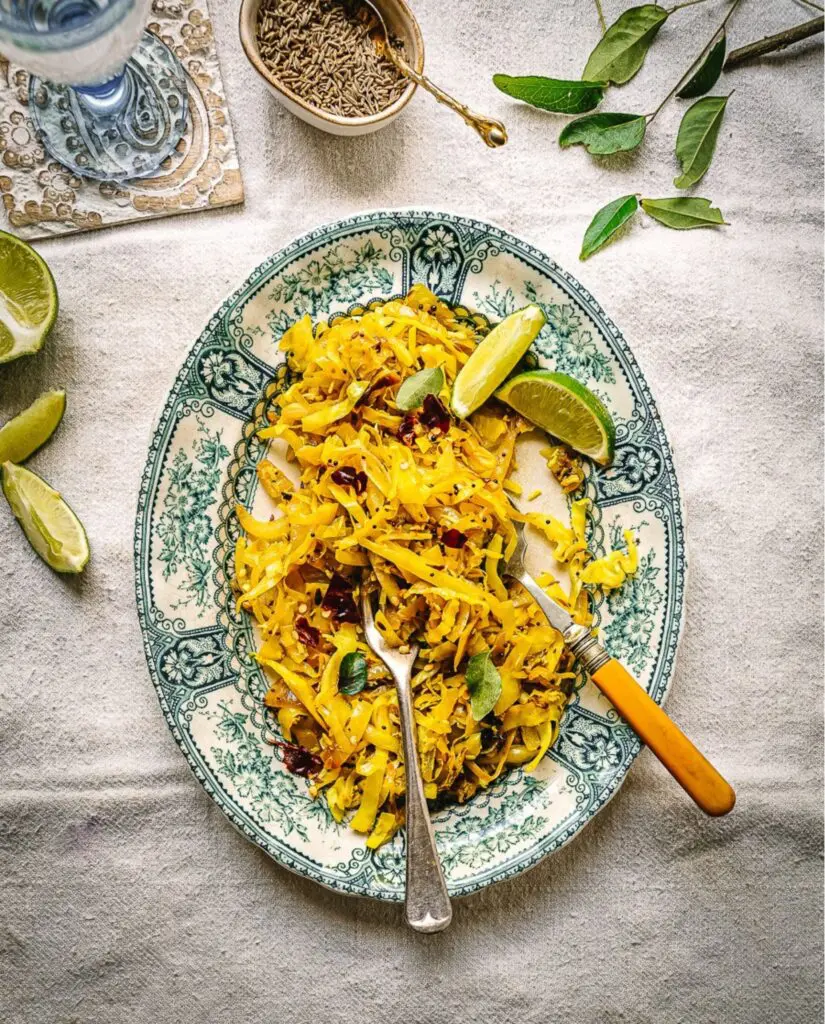
Sri Lankan Cabbage Mallung
A mallung is probably the easiest Sri Lankan dish to make. It’s stir-fried vegetables with the addition of spices, coconut, and a squeeze of lime.
When you travel to Sri Lanka you’ll most likely have a serving of mallung (sometimes called mallum) with a selection of curries.
If you’ve enjoyed eating Sri Lankan cuisine and you’re interested in trying to make a dish at home, then a mallung is the one to try. It’s easy to make, quick and simple. It only requires a few spices and vegetables you’ll find in your local supermarket.
You can make a mallung from a range of vegetables: leeks, kale, spring greens, broccoli, Brussels sprouts, and of course, cabbage.
There are just a few things you need to have to hand to transform your humble cabbage to make it crisp, golden, and delicious.
What spices do you use in cabbage mallung?
I always use whole cumin and mustard seeds when I make my mallung (based on a family recipe).
Curry leaves, fresh or dried?
Curry leaves are essential to Sri Lankan cooking. I’m liberal with my use of them. Scatter a couple of sprigs of leaves into your frying pan at the same time as your whole spices and chilli. You can use either fresh or dried. My preference is for fresh curry leaves (these can be stored in the freezer for use later).
You can find curry leaves in larger supermarkets, Asian grocery stores, or online retailers such as Red Rickshaw or Spice Kitchen. If you live close to Tooting, then Food City or Sharon sells fresh curry leaves.
Chilli, make this dish as hot as you like
Yes, you can have chilli, as much or as little as you like. A fresh green chilli deseeded and sliced, or a dried, crushed red chilli. Both are fine. Whatever you have to hand.
The onions hold the flavour
This will form the basis of the flavour of the dish. Don’t rush cooking your onions! Cook the onions slowly on low heat until they are soft, sweet, and translucent.
Give your cabbage mallung a golden hue with turmeric
I add a touch of turmeric to my cabbage mallung, not so much for flavour but to add a flash of yellow to the dish.
Maldive fish, great for flavour and purely optional
Many Sri Lankan recipes for vegetable side dishes will have Maldive fish. So this recipe isn’t strictly vegetarian or vegan.
Let me qualify, using Maldive fish is optional. If you can’t find it or simply don’t want to use it, then leave it out.
Maldive fish is a typical Sri Lankan ingredient, essentially dried tuna to add an umami flavour. You can find Maldive fish in Sri Lankan grocery stores such as Food City or Sharon. If you can’t get hold of Maldive fish, Japanese bonita tuna flakes are a good alternative.
Coconut and lime will bring out the flavour of your cabbage mallung
Lime and coconut are key ingredients in Sri Lankan cooking. Sprinkle generous tablespoons of coconut towards the final stages of cooking. Let the coconut cook until it’s toasty brown, then finish off with a squeeze of lime, which simply elevates the flavours of this simple dish.
Do I need to use fresh coconut?
Freshly grated coconut is great. You can buy frozen, freshly grated coconut. A good alternative is unsweetened desiccated coconut, which I have used for this recipe.
Sri Lankan Cabbage Mallung Recipe
Ingredients
- 2 tbsp vegetable oil
- 1 tsp black mustard seeds
- 1 tsp cumin seeds
- 1 green chilli, deseeded and finely chopped, or one dried crushed red chilli
- 1 tbsp Maldive fish (optional)
- Two to three sprigs of curry leaves stripped from the stem
- 1 onion finely sliced
- 1/4 tsp turmeric
- 400g white cabbage, outer leaves stripped, cut out the stem, then finely sliced
- A pinch of Salt
- 2 – 3 tbsp desiccated coconut
- Juice of a fresh lime
Instructions
- Heat the oil in a solid-based frying pan.
- Add the whole spices, chilli, Maldive fish and curry leaves. Heat until the spices start to crackle.
- Add the onion and turmeric and cook until they are soft and transparent. Stir so the turmeric evenly coats the onion.
- Now add the cabbage, stir into the spices, and cook until soft.
- Finally, add the coconut and stir through, and cook until the coconut just starts to turn golden.
- Finish off with a squeeze of lime and serve with rice and curry of your choice.

About Ranji Thangiah, Tooting Mama
Ranji Thangiah is a London-based food writer, photographer and podcaster living in the heart of the UK’s Sri Lankan community, Tooting, South London.
She is the host of the popular Sri Lankan food podcast, Tea with Tooting Mama, and runs the popular Sri Lankan food and culture substack, Tooting Mama.
She has been featured in the London Metro, BBC Travel, Time and Leisure Magazine. Ranji has demonstrated Sri Lankan cooking on stage at the Great British Food Festival and has appeared on BBC London Live. She is also one of the co-founders of the Sri Lankan Culture Collective which celebrates creativity among the Sri Lankan diaspora.
You may also like