

In Conversation with Fonsie: Tak Bat & Temple Life in Laos
ETG co-founder Sam Clark sat down with his guide in Luang Prabang to hear about his years as a novice monk and the lessons he still lives by. Sam took home more than a good story.

Plenty of guides in Laos can show you the sights. Far fewer can reveal the meaning behind them and send you home a little changed. Fonsie, one of our most senior guides in Luang Prabang, does both. When his daughters asked him about the morning almsgiving, which many visitors now treat as a photo-op, he explained it properly, drawing on the years he lived as a novice monk from the age of 14. ETG co-founder Sam Clark sat down with Fonsie to talk about the discipline and wisdom of those years and shares the unexpected insights he took home from their time together.
Early each morning in Luang Prabang, the monks walk out barefoot to collect alms. Most travellers who come to the town see Tak Bat, and many take part, cameras at the ready. Few guides can tell you the nuances behind the ritual, though. Fonsie can.
Fonsie has guided in Laos since 1999 and is now one of our most senior guides in Luang Prabang and the north. At 14, though, he was a novice monk, collecting alms himself.
So when his two daughters looked up at him at the monasteries and asked, “Why do we have to offer rice to the monks?”, he knew the answer from the inside. I sat down with him in Luang Prabang to hear it, and dig a little deeper.
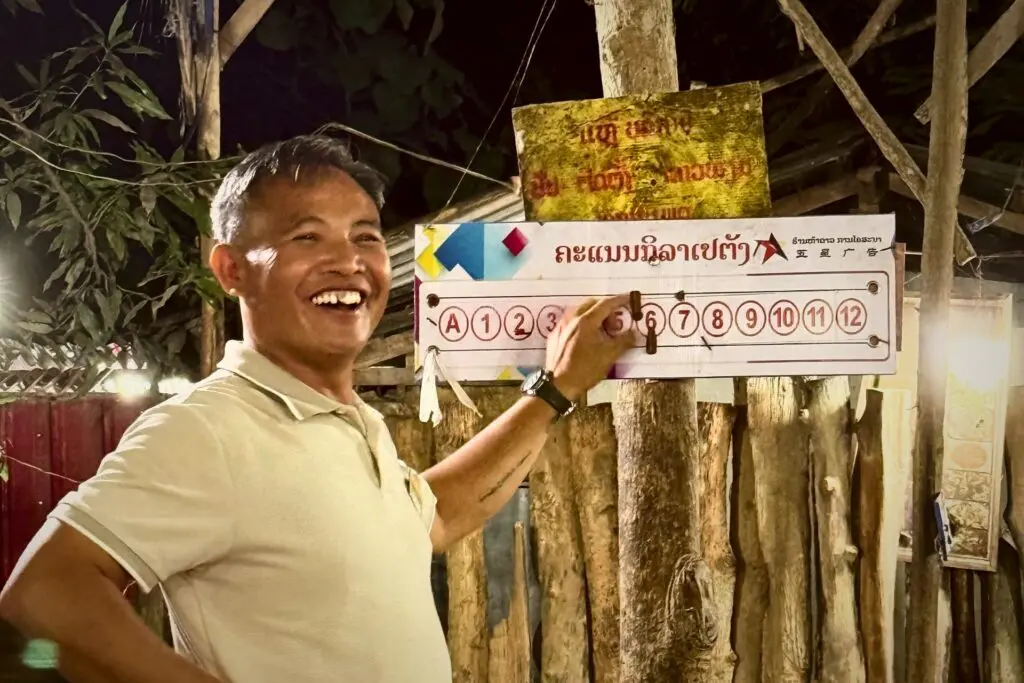
Fonsie in action, guiding in Laos.
Fonsie’s answer to his daughters’ question
Sam: Can you explain the alms-giving ceremony to us?
Fonsie: I took my children, my [two] girls, to the monasteries. I asked them if they had any questions. They asked the same question: “Why do we have to offer rice to the monks?” I said the Buddhist monks are devoted. They can stay without eating. But we do it for ourselves: loving kindness.
When you give something to someone else, what do you feel? You feel happy, because you have done a good thing. For yourself, not for others. And when the monk refuses what you give, you think, why did he refuse me? You feel disappointed. But if you just offer without expectation, you have done a good thing.
I was in the temple. I know what the monks are doing. They never ask you. They walk out barefoot. If you have something you’d like to give, you can give. If you don’t want to, you just stay away.
“The monks never ask.”
Becoming a novice monk at 14
Sam: How did you become a novice monk?
Fonsie: My parents are farmers, south of Luang Prabang, two hours’ drive from here. I have seven siblings, and I’m the second. When I was working on the farm, I always wondered. I asked my uncle, who is a teacher, how much he earned from teaching. He said about 200 kip a month [in those days]. I asked him, “Can I do that?” He said, “Yes, but you have to study hard to become a teacher.” My father said, “If you like to do that, you have to go to the main city for training, to become a teacher.” But we had no connections in the city. He gave me the idea. He said, “Some of them become a monk. Then they can go to study there, because the Buddhist school in the city will give you more opportunity.” I said that’s interesting. I didn’t say anything to him. I just said it to myself.
About one year later, when I was 14, I said, “Mom, I would like to become a novice.” She said, “OK, you can do that. If you want to become a novice, you must speak to the monk at the local temple.” [The monk said] “If you want to become a novice, you need to practise without dinner.” The first day didn’t work. I was starving. I went home and asked my mom, “Can I have some food?” She was really concerned. She said, “No, no, it’s not good for you.” I said, “I asked permission from the monk to come home. I’m a good boy.” I just said that. “OK, if you have permission, I will give you some rice.” The monk said, “Try to stop. Eat a little, a little, until you can stop dinner.” From big balls of rice, smaller and smaller, and on day five it worked. I said, “Oh good, I’m not hungry at all.”
Sam: So day one you cheated.
Fonsie: Oh yeah.
Sam: Day two you didn’t, but you were very hungry. Day three, very hungry. Day four…
Fonsie: “Very hungry, getting up to the top of the mountain. Day five, no problem.”
Life in the temple
Fonsie: When I got to Luang Prabang, the monks gave me books. “This is the book we need to learn.” 2,400 pages. I checked how many pages. He said, “Don’t check the last page. Start with one. Start with one, and then you will finish.”
I talked to the master. I said people at home have no idea of this Buddhist practice. He knew that already, because it is a small community. Very rarely would a monk go there, and even the monk there is just chanting in Pali. There is no meaning in it for life. Nobody understands. He said, “If you study here and succeed, you can teach your parents. You can explain to them.”
So I told my parents [what I had found]. I told my mom, “Calm down and focus on your breath, in and out. What is your mind thinking?” First, let it go. The second day, you try to bring it back. When you are mindful of your concentration, this will bring you peace.
Sam: Describe your day for us as a novice monk. I’m thinking about my 18-year-old and imagining him as a novice.
Fonsie: Four o’clock is for chanting. On a normal day, about 45 minutes. And meditation, at the beginning, just 10 minutes, because you are just learning. After the meditation we go to collect alms in the morning, like the monks do in Luang Prabang and elsewhere. Then we come back for breakfast at seven, and after breakfast we go to school. We walk back to the temple for lunch at 11.30, before 12. After 12, no more food at all until the next morning.
Sam: Any time for playing, joking with the other ones?
Fonsie: Not allowed. No sport. At 5.30 or 6.00, chanting again. Meditation.
Sam: How long did it take to build up the meditation?
Fonsie: “At least two and a half years. It’s not easy.”
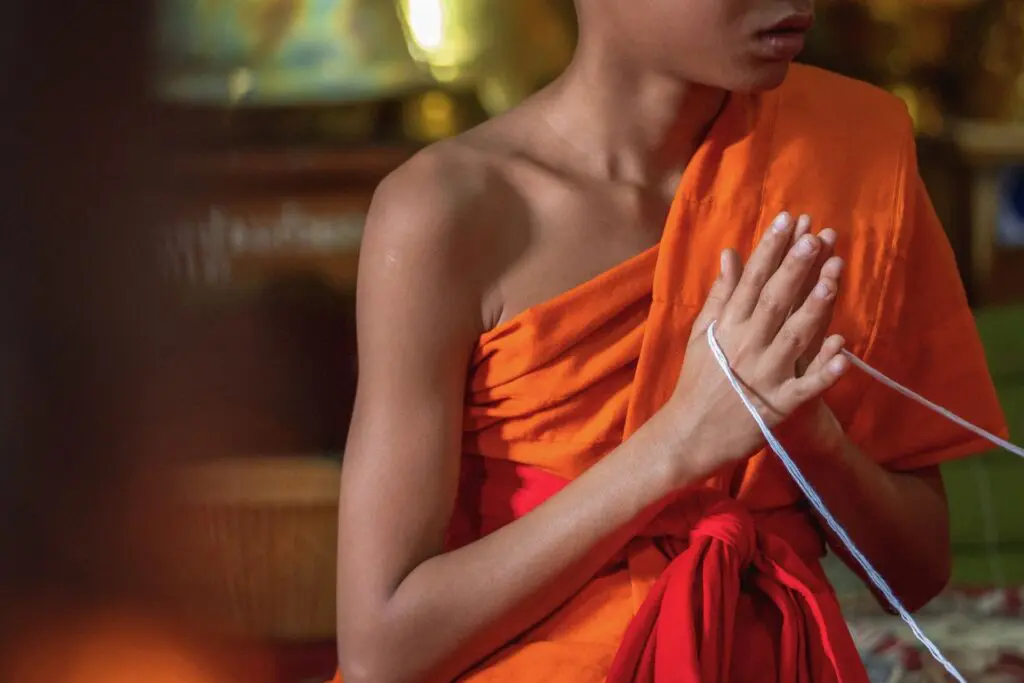
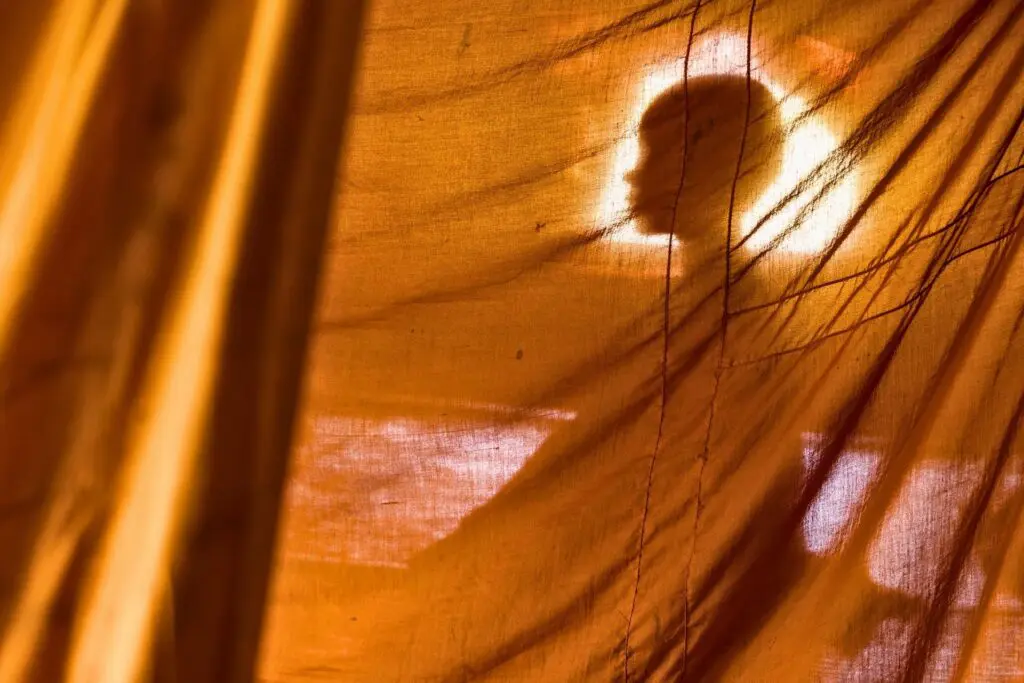
Novice monk in Laos, Credit: It’s Me Louis Photography for Amantaka
Fifteen days in the forest
Sam: When did you do the Vipassana forest retreat similar to the one I heard about during my visit to the Buddhist photography archive?
Fonsie: After the training, the master knew who could do it by himself. He could see us sitting there and knew the ones who could manage.
Sam: So being chosen felt like an honour, and you wanted to succeed?
Fonsie: Yes, that’s right.
Sam: And you went into the forest with the master. How many of you?
Fonsie: At that time, 20. I did it for 15 days. Not really sleeping, mostly meditation. We do some sleep. But the monk always said you can sleep, but not lying on your back. The body should be on the side, because when you wake you have more consciousness. If you lie on your back, it is not good for breathing.
“So even sleeping, we also do meditation. Focus the breathing, in and out.”
Sam: It must have been very hard at first for a 17-year-old. Was the fourth day the hardest again?
Fonsie: It was difficult at first, but again like getting up to the top of the mountain and coming down. Day five, no problem.
Fonsie’s favourite place to take travellers
Sam: Where in Laos do you most enjoy guiding?
Fonsie: The northern part, Luang Namtha and around, with the ethnic minority villages and trekking, is my favourite part to guide. I learn so much.
What is challenging is that we have different ethnic minorities, and with their culture it is very important to get the facts right. Many of the minorities are very shy to tell their culture. They never sit and tell you the full information. They’re not like, “Oh, I would like to tell you this and this.” Never happens. So we just sit there and talk, working with them, helping them, and day by day they tell the true story: “My father did that before.” And then we get all the facts right. This is what I learned mostly: learning by doing.
Sam: And what do your guests say about this?
Fonsie: Mostly they are interested, because they learn a lot too. For example, we eat whatever they cook. This is a highlight.
Staying present
Sam: What is the most important thing you would teach a young guide?
Fonsie: Sometimes people I work with say, “Why don’t you answer the phone?” I say, because when I’m working, I always stay in the present moment with the person I’m looking after. The guy said, “But sometimes this is something important we need to do.” I said, “No, you should know my schedule.”
“Any good [guide] should be absolutely with that person when they are guiding them, there with them in the present moment.”
What I took home
Listening to Fonsie explain Buddhist philosophy and mindfulness left a lasting mark on me. I came home from Laos with a renewed determination to deepen my own meditation practice as a way to navigate the noise of modern life. When I mentioned my initial struggles to Fonsie, he simply told me to forgive myself, reminding me that it is, after all, a practice.
It was a reminder that travel works best when it connects with where you are in life and what you actually need, rather than just what’s on a checklist. At Experience Travel Group, we use a discovery process called Envoy to understand each traveller’s underlying motivation (what we call your “Traveller DNA”), so we can design a journey around it.
We’re purpose-led, not preference-led: that’s how you end up sharing time with people like Fonsie, guides who uncover things you wouldn’t have known to look for.
Explore Our Laos Holidays
They offer a view into a destination; a theme, a route. There’s much to discover. Dive in.

Take the Next Step with ETG
Our knowledgeable team with deep regional insight, strong local partnerships, and first-hand experience, are expertly placed to design your holiday experience in Laos.
You may also like