

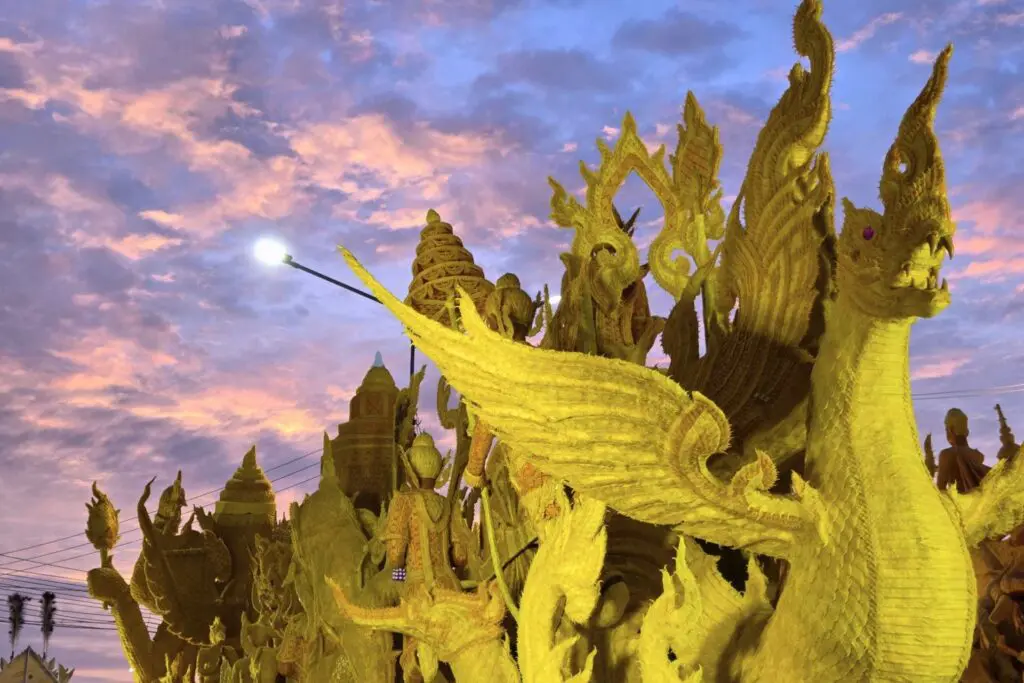
Untapped Thailand: Inside Ubon Ratchathani Candle Festival
Songkran gets all the attention, but there are plenty of lesser-known ones like Isaan's Candle Festival. It's run for over 100 years and is practically unheard of. ETG's Jamie went to scout it out...

Most travellers to Thailand celebrate Songkran and stop there, missing a festival that's been running in the country's northeast for over a century. When ETG's Jamie wanted to see a different side of Thailand, he spent three days in Isaan for the Ubon Ratchathani Candle Festival: carving wax himself, eating his way through the region's remarkable cooking, and standing in crowds far friendlier than in better-known spots. Here's his account, and why this pocket of Isaan deserves a place on more people's itineraries.
Even though I’ve lived in Thailand for years, I’ve only just started tapping into Isaan, the rural northeast of the country that borders Laos and Cambodia.
This region has a distinct cuisine that’s honestly become my favourite, ancient Khmer ruins, great swathes of farmland, and a slow pace of life.
Most people know about Songkran in Thailand, but there are festivals like the Ubon Ratchathani Candle Festival that are practically unheard of outside the country, despite running for over a century. So, I went to scout it out for curious travellers who want to see a different side of Thailand, and to join in with some community sanuk (fun).
Three days later, I’d carved wax into a temple candle with my own hands, eaten better than I ever expected (from street stalls to Michelin-recommended restaurants), and stood in crowds who were far friendlier, and far less used to seeing tourists, than in Thailand’s better-known spots. Here’s what it’s like to take part in this tradition of craftsmanship and community…
What the festival actually is
The Candle Festival (called Haetian in Thai) marks the start of Buddhist lent and takes place across Thailand, but Isaan does it properly, and the Ubon Ratchathani province does it biggest.
Originally, candles were donated to monks as a form of merit-making, so they’d have light to study and meditate by through Vassa, the three-month Buddhist Lent retreat. But after the invention of electricity, the offering itself modernised: it became an art form, with the wax sculptures growing more and more elaborate until it turned into the spectacle it is today.
It’s been running for 125 years, and has become a competition for the last hundred. Forty-seven districts each enter a candle carved with Buddhist motifs to be pulled through the city centre by tractor. The parade is accompanied by a procession of 2,500 traditional Thai dancers moving fluidly in unison, to the soundtrack of loud Mor Lam music on huge speaker systems. It all felt very Thai to me.
Day 1: Getting to grips with the candles
I was introduced to this cultural event by visiting the temples where the finished candles were stored in preparation for the parade. It felt like a real privilege to be able to admire all these pieces of craftsmanship, up close and ahead of the crowds.
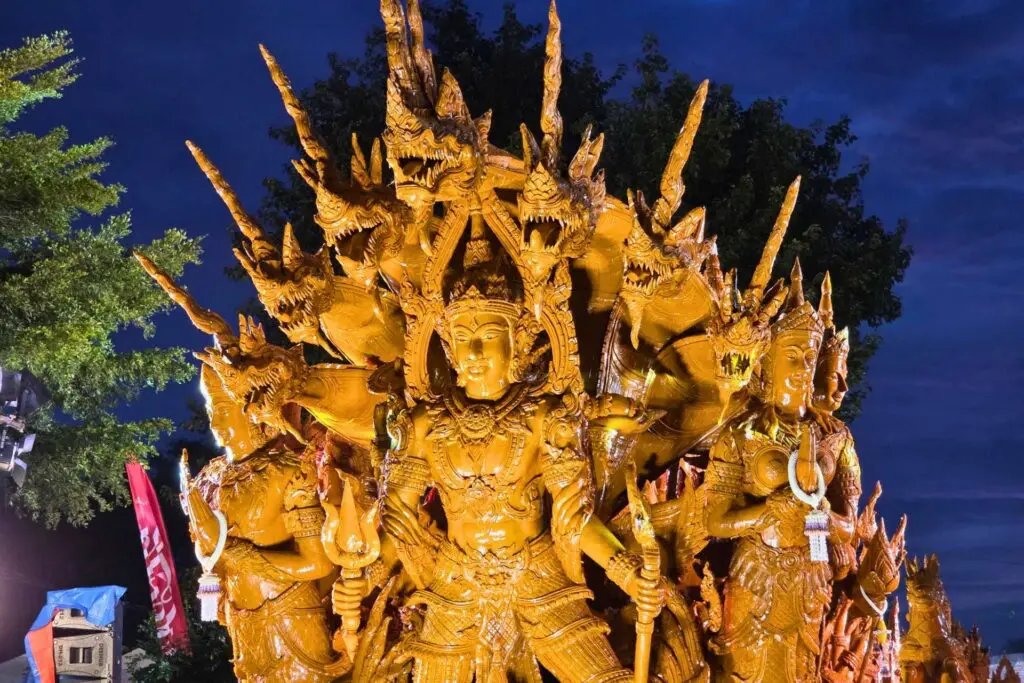
Don’t be fooled by the seemingly simple word, “candle.” They are more like sculptures. Even the small ones are the size of a car, and the largest weigh over five tonnes and tower well above head height.
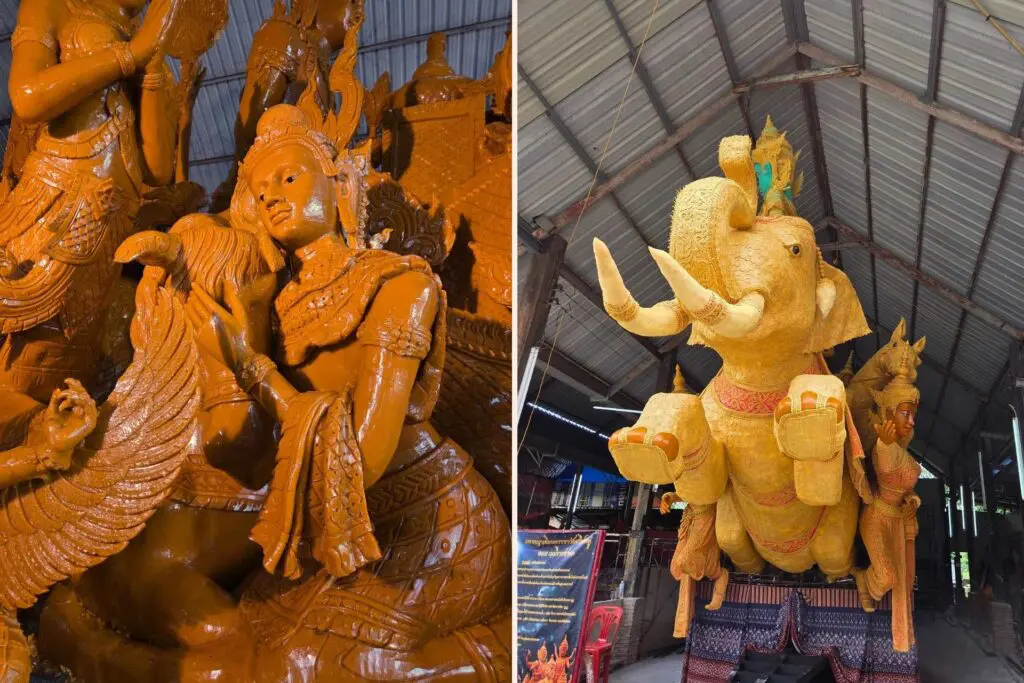
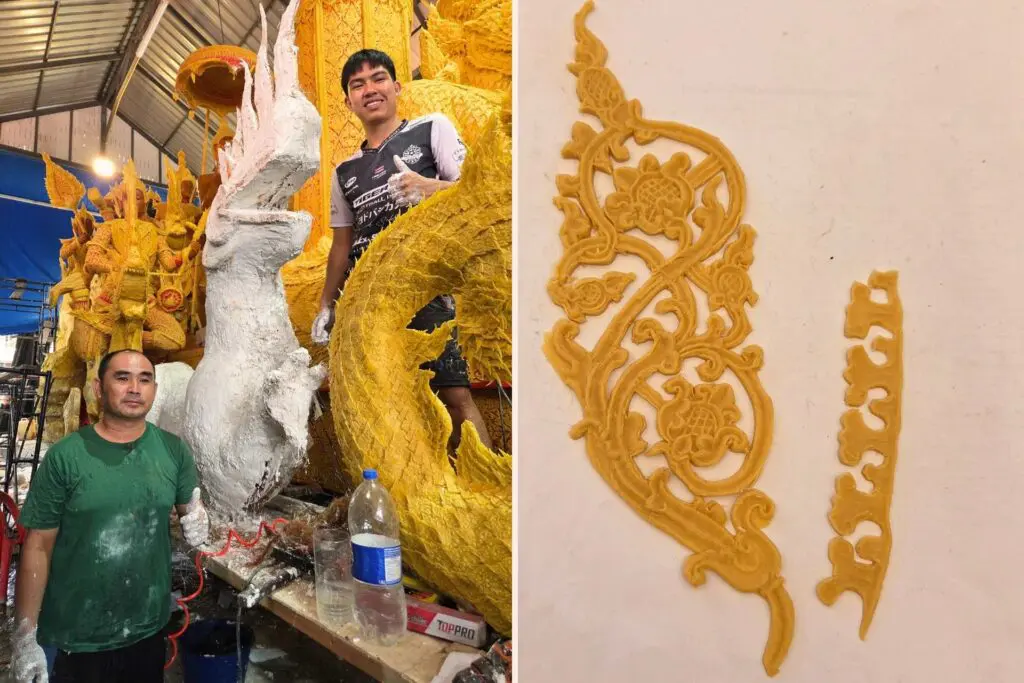
They take up to three months to make. First a metal frame, then plaster mixed with coconut husk for strength, then a coating of beeswax, and only then is it ready for the intricate carving. Every stage is a community effort.
My guide even encouraged me to have a go at pressing the wax myself and carving off the excess, a more delicate procedure than it sounds. It was pretty cool to think my carvings contributed to one of the temple’s own candles.
Day 2: time in the countryside, then the first taste of celebrations
We set off to explore the flat farmland that runs to the Laos border, the Mekong marking the line between the two. Green season had turned the whole province lush, which was vibrant even on an overcast day.
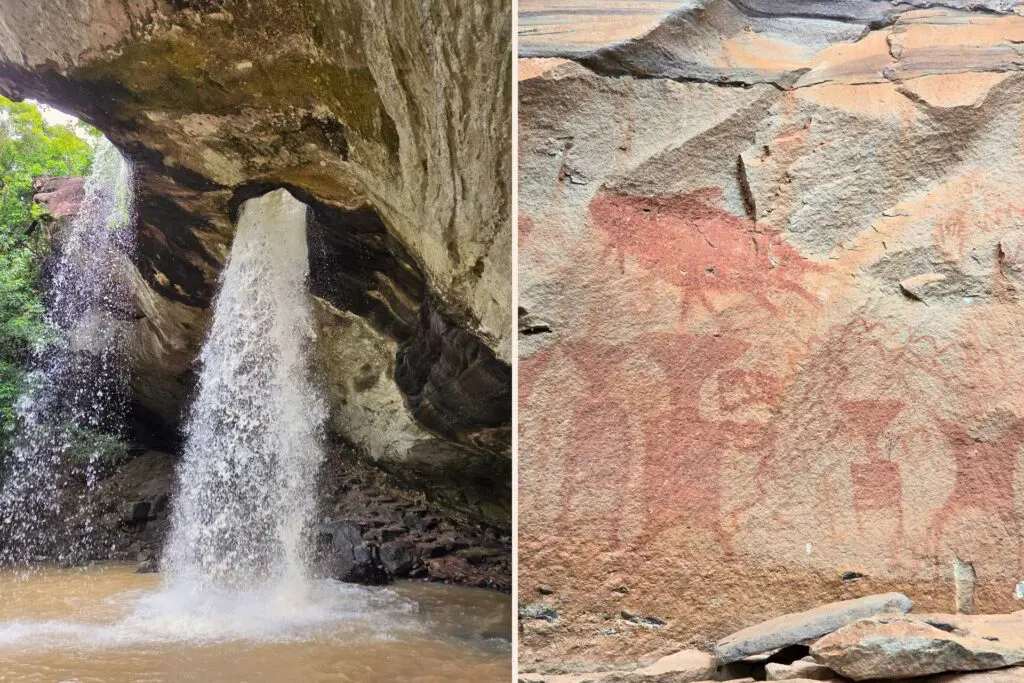
We stopped at Sang Chan waterfall, where the water drops through a round hole worn into the rock, then at Pha Taem National Park to see these pre-historic rock paintings. At Tohsang Cotton Village, we spent time with a small collective of local women who are preserving their heritage of hand-weaving cotton and mentoring the next generation.
Back in Ubon that evening, the festival atmosphere had started to set in. The candles came out for their first public showing, and were especially striking floodlit against a deep blue dusk. Music was blasting, and the smell of grilled skewers filled the air as families mingled all around me.
Day three: the legendary procession itself
This was the first of two procession days, when the candles are judged. It used to all happen in a single day, but is now split over two so more people can experience it. We had allocated seats in the stands, though it’s easy enough to just turn up and stand in the crowds as the candles pass through town.
The parade itself was quite something. Each district opens with a group of officials leading the way, followed by around a hundred traditional Thai dancers and a truck or band playing their music; the outfits, tunes and choreography changing each time. Then comes the candle creation itself; the themes and carvings vary too, but from what I could gather, most depict scenes or stories from the mix of Buddhism, Hinduism and animism that makes up Thai religion, all in amazing detail.
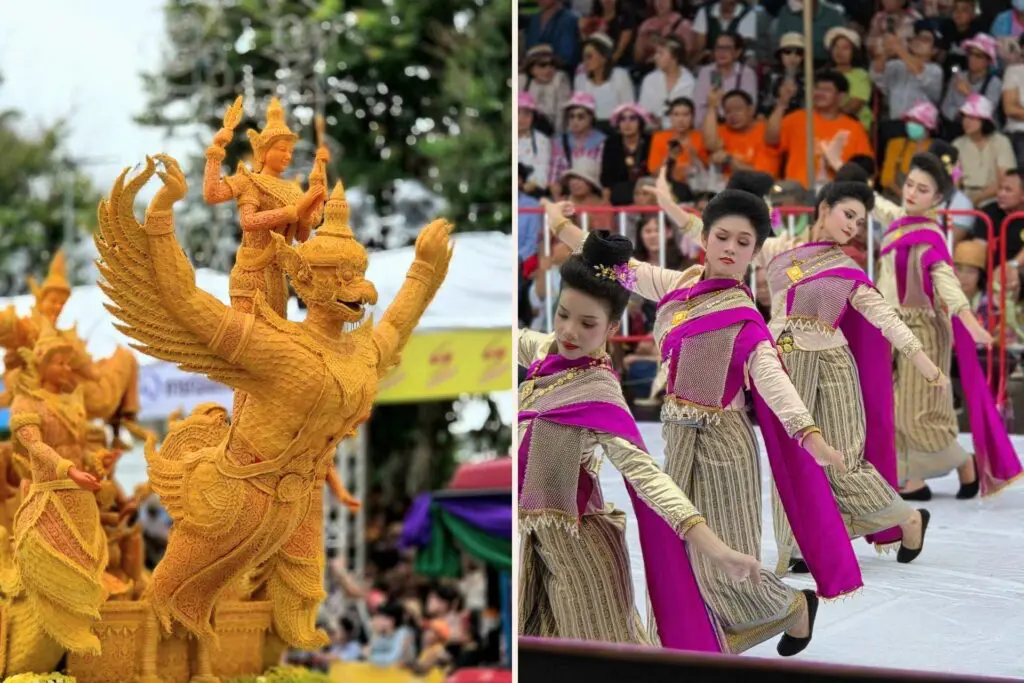
The parade runs most of the morning and turns into a proper street festival: the town centre is pedestrianised, vendors selling every kind of food imaginable (including fried insects) line the streets, and people dress up in cartoon character costumes. There are games set up and a fairground, with speakers pumping Isaan music to add to the atmosphere and local announcements throughout.
Speaking of the food…
In my eyes, the fiery food in Isaan is the best regional cuisine in Thailand, as it draws on both Lao and Cambodian cooking. It’s full of bold and umami flavours: chilies and fermented fish sauce add depth to dishes and certain aromatic herbs like kaffir lime leaves and dill add zing and freshness.
Ubon Ratchathani itself had a range of restaurants that surprised me too, from sizzling street stalls to numerous eateries recommended by the Michelin Guide, right there in the town.
My favourite dish was duck laab, a spicy duck salad that balances Thai and Lao flavours, made with toasted sticky rice powder, fresh herbs, and a sharp lime-and-fish-sauce dressing. If you’re a foodie, you’ll have heard of som tam, a pounded green papaya salad packed with lime, chillies, garlic and fish sauce. Don’t leave without ordering it here, since it originated in this region.
How to experience it for yourself…
Thankfully, Ubon Ratchathani is just a 1-hour flight from Bangkok, so it’s easy to weave Isaan into your itinerary.
We’d design a trip around the festival dates, as well as wider exploration of this pocket of Thailand that most visitors never reach. Browse our holiday idea below.
Explore ETG's Itinerary

Take the Next Step with ETG
Our knowledgeable team with deep regional insight, strong local partnerships, and first-hand experience, are expertly placed to design your holiday in Thailand.

You may also like